Schneider National Shifts Entire Eastern Intermodal Operations to Norfolk Southern in Major Rail Realignment

In a monumental structural shift within the North American freight logistics sector, Schneider National has announced the complete transition of its eastern intermodal rail business from CSX to Norfolk Southern. The sweeping strategic realignment, disclosed concurrently with Schneider’s third-quarter financial earnings report, establishes Norfolk Southern as the exclusive eastern rail partner for Schneider, perfectly complementing its longstanding western partnership with Union Pacific. This high-stakes operational pivot is designed to aggressively capture market share, unlock significant network capacity, enhance service flexibility, and accelerate the broader industry objective of converting over-the-road truck freight into efficient rail intermodal volume.
The decision to sever ties with CSX and consolidate eastern intermodal operations under Norfolk Southern represents one of the most significant carrier realignments in the freight sector in recent years. Industry analysts note that such massive network migrations are rare, typically precipitated by rigorous long-term evaluations of service reliability, route density, terminal proximity, and overarching corporate growth strategies. For Schneider National—a premier multimodal provider headquartered in Green Bay, Wisconsin—the move signals an aggressive posture aimed at positioning the enterprise for sustained expansion as the freight market navigates a complex macroeconomic cycle.
Strategic Evaluation and Network Optimization
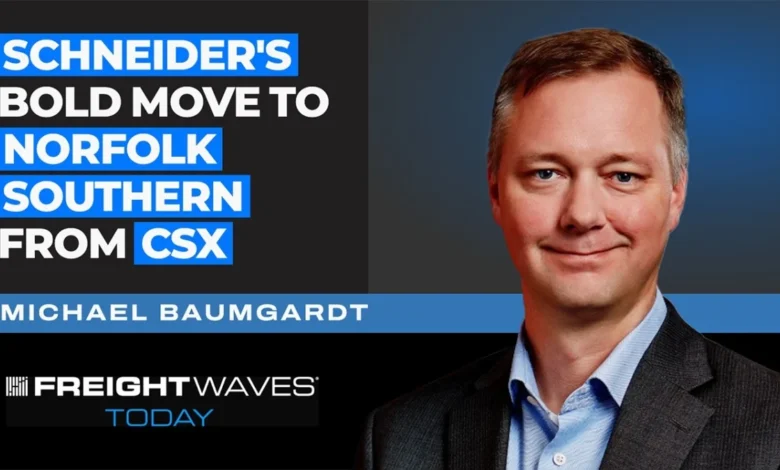
According to Michael Baumgardt, Schneider’s Executive Vice President of Intermodal and Logistics, the sweeping partnership followed an exhaustive internal review spanning multiple operational metrics. Leadership closely scrutinized network reach, train frequencies, and the physical proximity of rail terminals to major metropolitan population centers. The fundamental catalyst, Baumgardt emphasized, was growth—specifically, identifying how Schneider could draw closer to its core customer base and streamline supply chains by migrating highway freight onto intermodal corridors where modal economics and sustainability metrics converge.
Customer reception during the critical first 24 hours following the public announcement was described as overwhelmingly positive. Shippers reportedly expressed strong confidence in Schneider’s distinct asset-based operating model, which integrates company-owned drivers, company chassis, and company-owned containers. This vertically integrated framework mitigates many of the fragmented handoff vulnerabilities that plague third-party intermodal arrangements, providing shippers with end-to-end visibility and consistent service accountability.
Norfolk Southern’s Path to Exclusive Partnership
From the perspective of the eastern carrier, securing Schneider’s entire book of eastern intermodal business is the culmination of a multi-year capital allocation and operational scaling strategy. Shawn Tureman, Norfolk Southern’s Vice President of Intermodal and Automotive Marketing, noted that the railroad has methodically built toward this milestone for over a decade. By 2018, Norfolk Southern had solidified its standing as the second-largest intermodal franchise in the United States.
Building upon that foundation, railroad leadership established an ambitious target in 2022 to double the capacity and volume of its intermodal franchise once again. To achieve this, the company has deliberately directed significant discretionary capital expenditures toward terminal expansions, track enhancements, and digital infrastructure. Tureman underscored the symbiotic nature of the alliance, remarking that achieving such aggressive growth targets requires partnering with industry giants like Schneider.
Economic Pressures and the Current Rate Environment
The timing of the migration is heavily influenced by prevailing macroeconomic conditions and structural dynamics within the broader freight transportation market. Currently, traditional truckload (TL) spot and contract rates carry a substantial pricing premium—often exceeding 30%—over competing intermodal services. This wide cost differential creates a compelling economic incentive for shippers to optimize their logistics networks by shifting eligible freight from the highway to the rails.
Despite the economic advantages of intermodal transport, supply chain bottlenecks frequently shift from line-haul transit to local execution. Baumgardt pointed out that equipment availability is not a primary constraint, as an adequate supply of containers and chassis exists within the network. Instead, the persistent operational bottleneck centers on drayage capacity and qualified driver availability. Baumgardt argued that Schneider’s proprietary asset-based model—anchored by company drivers rather than an exclusive reliance on third-party owner-operators—provides the company with a robust structural advantage in managing local pickup and delivery constraints efficiently.
The Broader Context of Railroad Consolidation
The announcement inevitably invites industry-wide speculation regarding ongoing merger and acquisition activities within the Class I railroad sector, most notably the discussions surrounding potential synergies between Norfolk Southern and CSX. Both Baumgardt and Tureman addressed the topic directly, clarifying that prospective merger discussions were not the primary driver behind Schneider’s realignment.
Nevertheless, both executives acknowledged that potential future rail consolidation could serve to amplify the long-term benefits of the new partnership. Baumgardt characterized potential merger outcomes as "icing on the cake" regarding enhanced service velocity, network reliability, and transit speed. Tureman echoed this sentiment, suggesting that any future structural integration that reduces interchange friction, enables shorter routes, and facilitates single-line service would ultimately deliver profound value to Schneider’s shipper base.
Seamless Transition Planning and Execution
With the agreement finalized, executive teams from both organizations have initiated comprehensive transition planning to ensure zero disruption for active shippers. Tureman revealed that Norfolk Southern proactively pulled forward specific infrastructure investments in anticipation of increased volume density, positioning the railroad to absorb the additional traffic without experiencing operational degradation.
The primary operational mandate for both companies is absolute continuity. Tureman expressed his primary benchmark for success: three months post-transition, customers should remain entirely unaware that a monumental operational migration has occurred. A frictionless handoff will establish a vital operational baseline, paving the way for joint commercial sales initiatives targeting a projected robust intermodal market cycle spanning 2026 and 2027.
Financial Performance and Strategic Pillars
The strategic realignment coincides with positive financial indicators reported in Schneider’s third-quarter earnings statement. The company’s intermodal division demonstrated steady revenue and volume growth, aligning with management’s core strategic pillars: logistics expansion, dedicated fleet services, and intermodal intensification. Although dedicated revenue per truck experienced a modest 3.1% year-over-year increase during the quarter, leadership continues to emphasize disciplined freight selection, margin protection, and prudent driver resource allocation as essential operational disciplines while navigating the ongoing freight cycle.
Fact-Based Analysis of Market Implications
The transition of Schneider’s eastern intermodal business from CSX to Norfolk Southern carries far-reaching implications for the competitive landscape of eastern U.S. rail freight. For CSX, the departure of a high-volume premier intermodal customer represents a notable volume reallocation, requiring the carrier to backfill network capacity with alternative business streams or wholesale spot market opportunities. Conversely, Norfolk Southern secures a massive, stable volume anchor that validates its capital expenditure strategy and enhances asset utilization across its eastern corridor network.
For shippers, the concentration of Schneider’s eastern volume onto Norfolk Southern simplifies multi-modal coordination while aligning two industry leaders committed to aggressive highway-to-rail conversion. As shippers increasingly face margin pressures and sustainability mandates to reduce corporate Scope 3 emissions, the combination of Schneider’s asset-heavy drayage network and Norfolk Southern’s expanded intermodal capacity offers a formidable alternative to long-haul trucking. Ultimately, the success of this strategic realignment will be measured by execution: maintaining service reliability through the transition phase and capitalising on structural cost advantages as the freight market evolves toward the latter half of the decade.